

Can I Ise Spray On Sunscreen Over My Makeup
Affiliate Disclosure: I receive a pocket-sized commission for purchases made via affiliate links.
Today's video is on ane of the more usually asked questions I get about sunscreen. You put your sunscreen on in the morn, apply your makeup over information technology… but yous're meant to reapply it every 2 hours. So how exercise you reapply it without messing upward your makeup? And do you really need to reapply it?
Here's the video on YouTube, including a demo of how I do information technology and some cool footage of sunscreen sprays – scroll down for the text version.
Why do you demand to reapply sunscreen?
If you look on your sunscreen, you'll notice that it says to reapply regularly, ordinarily every 2 hours. That's considering sunscreen gets less constructive over time.
Firstly, sunscreen comes off if you brush against information technology – with your hands, your wearing apparel and your hair. The less sunscreen you have on your peel, the less protection yous get.
Related mail: What Does SPF Mean? The Science of Sunscreen
Secondly, when yous first apply sunscreen, if you apply enough, it'll form an fifty-fifty, continuous film that protects your peel. But over fourth dimension, the sunscreen film breaks up as information technology interacts with the oil and h2o that your pare produces throughout the 24-hour interval. It'south worse if there'southward whatever heavy sweating. The layer also breaks up and clumps into bits every bit your peel moves around – when you lot talk and eat and yawn.
These photos aren't sunscreen just foundation – it's another product that'due south designed to stay on your skin in an even motion-picture show for as long equally possible, so it uses some of the aforementioned technologies, and it'southward much easier to see.
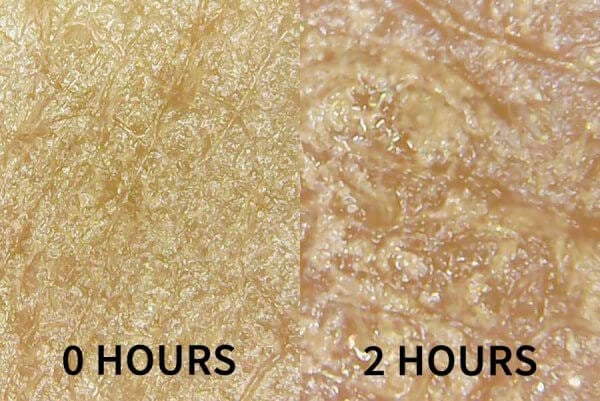
The microscope photo on the left is right after awarding, and the photo on the right is after a few hours. You can see that information technology clumps up and moves effectually, migrating into pores and creases on your pare over time.
Related post: Foundation Clumping Scientific discipline, and How to Fix It (with Video)
The sunscreen motion-picture show also gets thinner every bit time goes on, because it evaporates and is absorbed into the peel. This changes the absorption properties of the film for the worse.
The concluding reason, just probably the one that nearly people know, is that some older organic "chemical" sunscreens aren't photostable. This means they break downward after absorbing too much UV.
Sunscreens these days are usually formulated to exist photostable – they apply photostable organic or inorganic filters, or they use photounstable filters in ways that increase their photostability. That means they don't have this specific problem, only they're nevertheless affected by the first ii bug, and then they'll yet become less effective over fourth dimension.
Related post: Chemic vs Physical Sunscreens: The Scientific discipline (with video)
So after you apply sunscreen, the moving picture wears down and you stop up with less and less sun protection as time goes on.
But how much less?
How much protection is left after two hours?
Unfortunately at that place isn't that much info on how long sunscreen lasts on your pare if yous aren't moving around much. There'southward just 1 study directly on this topic so far that I could find (thanks to Kind of Stephen).
20 people practical 2 mg/cm2 of sunscreen with a dye in it, so the researchers could easily photograph where the sunscreen went every 2 hours. They didn't use any other products on their face, and they were allowed exterior for upward to an hour.
Hither's a graph of what happened (majestic line is the average, grey shaded area is the range):
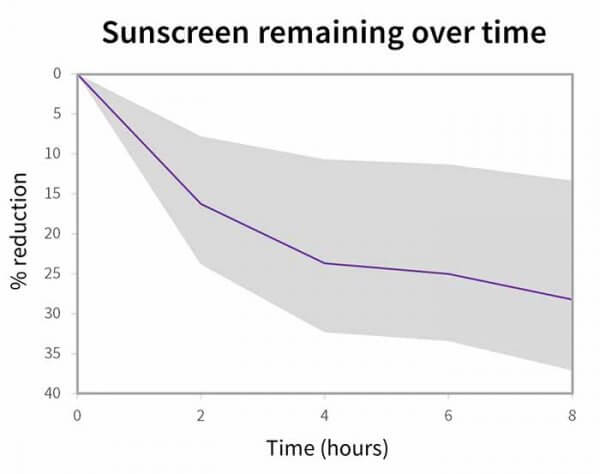
After 2 hours, in that location was an average of 16% less dye. Afterwards 4 hours it was vii% less than that, and and then after 8 hours it was another 4.v% less – a total of almost 30% less dye, which means probably somewhere in the region of xxx% less sunscreen coverage.
We can't confidently say that these results will be the same for every sunscreen since different sunscreens have different lasting power – water resistant sunscreens stay on peel for longer even when they're being disturbed, and some chemical sunscreens do absorb into the top layers of pare which helps them last. But it's likely that in that location's still a significant amount of protection on your skin at the stop of the day from most sunscreens, if you don't movement around much.
As an indication, if you take xxx% away, SPF 50 becomes SPF 35, SPF xxx becomes SPF 21, and SPF xv becomes SPF x (SPF varies approximately linearly with the amount of sunscreen on your skin). The higher the SPF you offset off with, the more probable it is that y'all'll take more protection left at the end of the day.
Merely is this protection plenty?
Similar I said in my mail service on wearing sunscreen indoors, how much protection yous need depends on both how much UV yous're exposed to, and how concerned you are virtually the effects of UV (the main issues for most people are skin cancer, wrinkles and hyperpigmentation).
If you're reapplying sunscreen on top of makeup, you'll have to mess up your makeup to some extent, or apply less sunscreen, or utilise less evenly. At that place isn't really a fashion to avoid this compromise.
I've divided my approach to reapplying sunscreen into three general situations which work for me:
Situation 1: Minimal Sun
This is if I'grand not going to become much sun – for example, if I go to work in the morn, get more often than not indirect lord's day exposure within the showtime 2 hours, then at the end of the day I get home and virtually of my commute is in the dark.
In this sort of situation, I don't reapply. I rely on my residual sunscreen to become me through and try to avert sunday exposure – goose egg too extreme, but I'll walk on the shady side of the street and I'll sit down abroad from the window on the train.
This is well-nigh days, and I've institute that for me, with the sunscreens I'm using and my skin blazon and my sun exposure situation, that'due south plenty. My freckles have lightened and mail service-inflammatory hyperpigmentation fades quickly, which I call up is a proficient sign that I'grand getting significant sun protection.
Related post: Video: My Top six Favourite Sunscreens
Situation two: Lots of Sun
Let'due south become to the other extreme: when I get a lot of unavoidable sun exposure.
For example, I have breakfast in the morning time with a friend, then nosotros go on a four hour walk effectually some nice beaches. I know I'm going to get a ton of lord's day exposure no matter how hard I try, and I'm probably going to sweat a whole bunch, and I really need to be applying my sunscreen every 2 hours or I'1000 going to get sunburnt.
In this state of affairs, I put on h2o resistant sunscreen and go along my makeup unproblematic – for case, tinted moisturiser and blush, or maybe even only concealer in the key areas. I don't fifty-fifty bother with products that need to stay on specific areas of my face, the priority is sun protection. Then every two hours, I reapply water resistant sunscreen and that minimal makeup if necessary.
When reapplying, you don't need to wash off your sunscreen or anything – y'all tin can just reapply sunscreen on top. If there's clay on your face or the layer is getting too thick, you tin use a makeup wipe to get some off your face (especially if there'south dirt, yous don't desire to exist exfoliating away at your pare every time you reapply!). If you lot intermission out from repeated reapplications of a sunscreen that's usually fine, it might besides be worth removing some with a makeup wipe.
I'll likewise vesture a hat and sun-protective clothing, and reapply sunscreen on my body regularly as well.
Situation 3: Some Lord's day
And so there's the in-between situation, which I call back is the one nigh people are wondering almost – where you want to expect skilful with most of your makeup intact, merely yous as well need to reapply a decent amount of sunscreen.
For case, I'm working in the office, simply and then I go for a nice long walk for tiffin, and and then I accept a sunny afternoon ride on the train to become home and the sun is coming in horizontally through the train windows. In this state of affairs I'll have my standard amount of makeup and the sunscreen I practical in the morning time, but I'd desire to to reapply sunscreen on top.
The well-nigh important affair to recall is that dominicus protection scales with the amount you apply. On average, this is pretty much linear. If you utilise around ¼ teaspoon on your face, y'all'll get the protection on the label, but if you apply half of that, then you'll get half the protection. So it'southward a affair of getting as much sunscreening product as possible onto your confront in an even layer, while disturbing the makeup that's already on your confront as little as possible.
Related video: How Much Sunscreen Do You Demand For Your Face?
Which production should I use for reapplication?
Let'due south talk nigh the unlike products you might employ for reapplication, starting with the ones I wouldn't recommend:
Foundation
There probably isn't enough protection in SPF-rated foundation on its own. Co-ordinate to a 2006 report, an average awarding of liquid foundation is 0.54 chiliad, although at that place was a lot of variation.
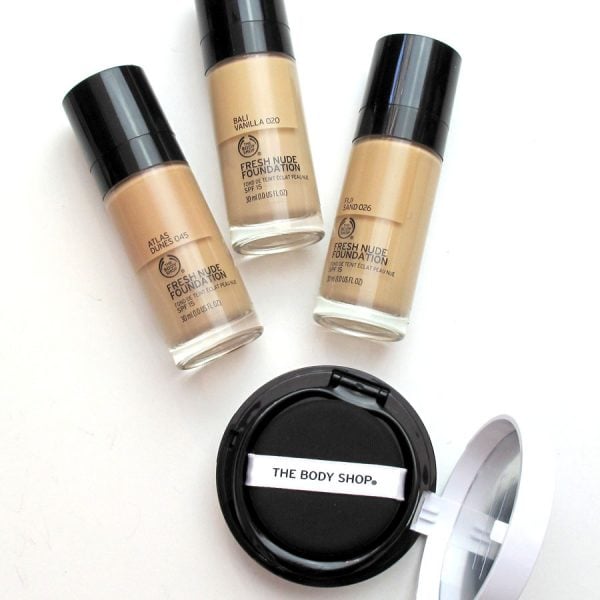
For that average 0.54 g of foundation on a 400 cm2 face, you'll get these bodily SPFs:
- SPF 50 → SPF 34
- SPF 30 → SPF 20
- SPF fifteen → SPF 10
I use one pump of my foundation from The Body Shop which works out to be 0.2 m. With that amount, you'll go these bodily SPFs:
- SPF 50 → SPF 12.v
- SPF xxx → SPF 7.v
- SPF 15 → SPF iii.8
Powders
Powders are even worse. The Cosmetic, Toiletry, and Fragrance Clan did three studies on 10 000 women in the The states in the 80s and plant that an average application of face powder was 85 milligrams. On a 400 cm2 face:
- SPF l → SPF 5.5
- SPF xxx → SPF 3.ii
- SPF xv → SPF 1.six
In that location'south besides the consequence that powders probably don't cover your face in a continuous even layer.
It'south possible that in that location are technologies in powder sunscreens that brand them apply more than densely than regular powders, and then I asked a agglomeration of pulverisation sunscreen companies if they had data on the expected protection with a typical awarding of their products. The answers I got back were really variable, and as much every bit I want convenient pulverisation sunscreen to be a thing, I didn't find the data all that compelling.
Overall, it just seems actually unlikely that people tin utilise
- enough powder
- reliably every time
- in an fifty-fifty continuous layer
to get significant coverage, even as a peak upwards method.
The near promising data I got was from Colorescience. Their specially treated powder is designed to stick to pare amend for a greater awarding amount, and it's actually fourscore minutes water resistant. This rating is significant because it means it was applied on people'due south skin, then they sat in a jacuzzi for iv sessions of twenty minutes before the UV protection that was left was remeasured to be SPF 50. After one of these tests the powder left on the pare of 3 subjects was measured – at that place was an average of 0.542 mg/cm2 of product remaining.
This probably doesn't happen with virtually powders – an average application of 85 mg would requite less than half of this – so I was pretty impressed. I think it works well because their formula has a actually high percentage of minerals in information technology, along with the special coating.
The bad news: to get this result they applied 2 mg/cm2 of powder onto the skin, patted it into an even layer, and then left it for 15 minutes before going into the h2o. So application-wise, information technology seems pretty unrealistic.
Even if we assume that the extra powder wasn't necessary, 0.542 mg/cm2 is also quite a lot of production – nigh 0.22 g for a full face up awarding.
According to a Colorescience study, to become that much product out of the brush (note: not necessarily onto your face), you have to swirl the brush around your face up for a total 60 seconds, priming the brush 4 times in the process (this involves tapping it sharply on the table a few times and flicking it until information technology produces a puff of powder). threescore seconds is 6 Happy Birthdays, in the electric current standard unit of measurement of time – again, I think that'due south unrealistic, particularly since the instructions don't tell you to prime number the brush that much, it's hard to see how much powder really comes out of the brush, and the castor dispenser mechanism doesn't dispense powder at a consistent rate.
Plus with pulverization sunscreens, a lot of them come in very pocket-size pack sizes – 2.5 to vii k – so the cost adds upward pretty quickly.
Equally far every bit powders become, I think Colorescience is probably your best bet, and in general if they're water-resistant I recall they'll perform better since they become through that jacuzzi test earlier their SPF is measured. But other formats are probably more reliable and more likely to be effective.
Then there's only really two reliable options that I've come beyond so far:
Sprays
Spray sunscreens are an option that I've warmed up to since trying out a few in the past year. The evenness of coverage can actually exist a lot amend than creams since they tend to have a low viscosity – they're runny enough to get into the valleys in your skin. Fifty-fifty though at that place's droplets, if you apply enough layers y'all become pretty decent coverage.
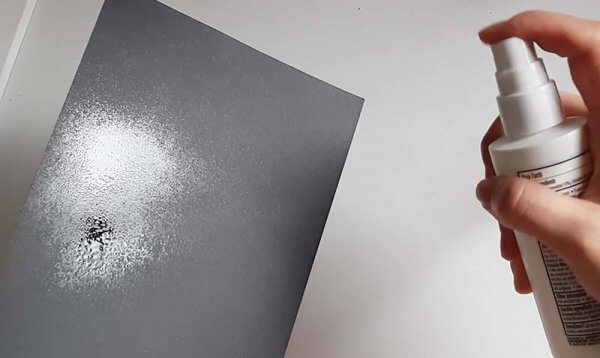
Again, the main issue with sprays is with the amount you employ. Information technology's easy to underapply if you just mist the sunscreen on similar a setting spray. Instead, I'd recommend applying a bunch of sparse layers and letting them dry in between and so your makeup doesn't run.
You lot tin can spray your spray into a quarter teaspoon measure to work out how many sprays y'all demand to get a reasonable amount of sunscreen. With the 3 I tried (Neutrogena Ultra Sheer Face Mist SPF 55, Soleil Toujours SPF 30 Gear up + Protect Micro Mist, Bioderma Hydrabio Eau de Soin SPF thirty), I constitute that information technology was between iv and 9 full pumps to go a quarter teaspoon (I recommend measuring your own ones, in instance your packaging or your spraying method is slightly dissimilar).
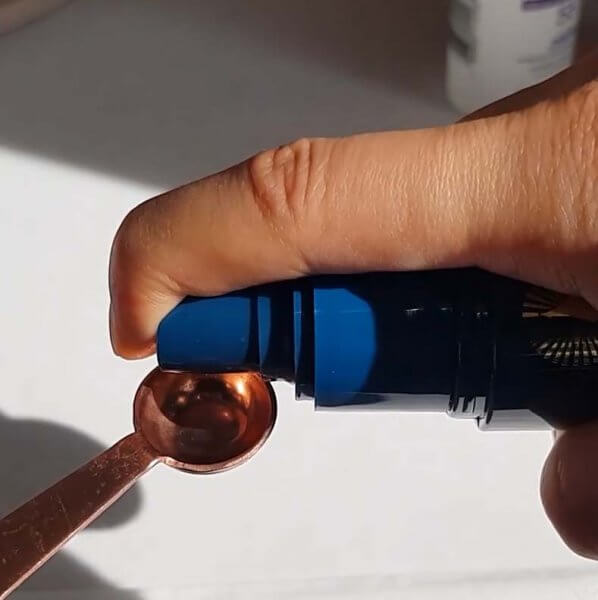
In that location's an additional issue with droplets sunscreens – these are the ones in pressurised metal cans which contain propellant (they continuously spray when you hold the top downward). A test from Choice magazine found that only xl-60% of the sprayed product was sunscreen, with the rest being propellant. Since the SPF examination is performed before adding the propellant, you'd actually need to apply a fair flake more to become the labelled SPF protection.
A few extra tips for using sprays:
- Be careful not to inhale spray sunscreen (it's not good for you, peculiarly if it's a mineral sunscreen). Hold your breath, apply a layer, and then walk a few steps out of the cloud before breathing again.
- Be conscientious when applying sprays outdoors so the wind doesn't blow information technology into your eyes or just… away (that wastage!).
Balm
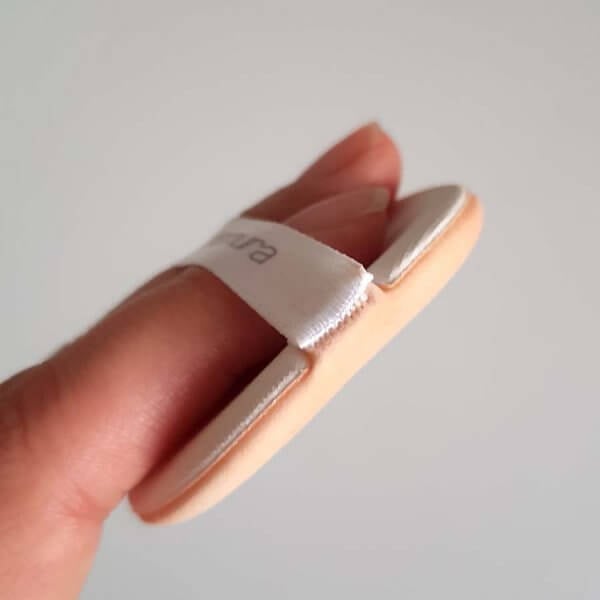
The other choice that I think works actually well is applying your regular sunscreen lotion over your makeup with a cushion puff (I rescued this one from a Shu Uemura foundation cushion, but y'all can buy inexpensive ones online for less than $2 each).
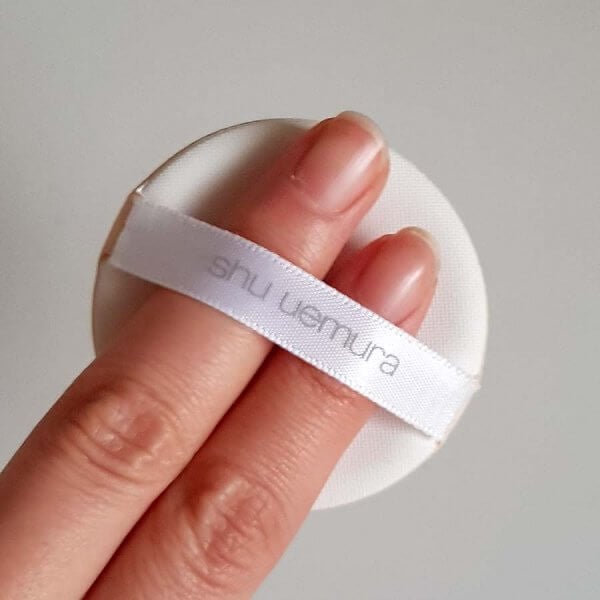
James and Robert Welsh recently did a video about how to utilize sunscreen over makeup, and they recommended cushion compacts as a good compromise between lord's day protection and non messing up your makeup. Simply, as they mentioned, these tend to use mineral filters which tin can give a white cast.
So what I prefer doing is using a cushion applicator to pat on my regular sunscreen. I talked well-nigh this in my sunscreen and makeup video – I first read about this technique in the Asian skincare community about half-dozen years ago. Some people even buy an empty cushion container to put their sunscreen in, simply I don't think information technology'south necessary. Cushion puff applicators are ordinarily no more than a couple of dollars each.
There are a lot of things I love most cushion applicators. They're a lot thinner than regular beauty sponges, and so they don't soak upwards as much sunscreen (once more, the awarding amount matters). They're easy to conduct effectually (y'all tin can put 1 in a ziplock bag to keep it clean), and y'all tin fold it to go information technology into tight areas around your olfactory organ and eyes.
The demonstration of my reapplication in the video starts at around 13:10. I observe that this method works best with a lightweight silicone-based sunscreen – I'thou using Klairs Soft Airy UV Essence in the video (I reviewed it earlier here).
The trickiest bit is not transferring any of the coloured makeup to the parts of your face that don't have colour. I start with a couple of layers on the skin coloured bits, and so motion onto the coloured sections. I don't think information technology'due south possible to reapply over eyeshadow without ruining it – peradventure don't wear eyeshadow, or reapply your eyeshadow afterwards (using a single color might be less annoying).
Whatever reapplication method you lot're using, it's a good idea to cheque if the ingredients are uniform. Some ingredients tin can pause downwards others, but the bear upon is probably pretty low (there's more nigh this in the free sample chapter of my eBook). When in uncertainty, you lot can always just reapply the aforementioned sunscreen you used in the morning.
If you accept a sunscreen reapplication hack I haven't mentioned, share information technology in the comments!
Selected References
(There's a lot of stuff that I've mentioned in older videos and posts – the references are in those!)
Rungananchai C et al., Sunscreen application to the face persists beyond 2 hours in indoor workers: an open-label trial, J Dermatolog Treat 2019, thirty, 483-486. DOI: 10.1080/09546634.2018.1530440
Loretz L et al., Exposure data for personal care products: hairspray, spray perfume, liquid foundation, shampoo, torso wash, and solid antiperspirant, Food Chem Toxicol2006, 44, 2008-2018. DOI: 10.1016/j.fct.2006.06.029
U.s.a. EPA, Chapter 17 – Consumer products, in Exposure Factors Handbook 2011.
Colorescience submission to the FDA (esp Attachments 2, half-dozen, 7, 8): https://www.regulations.gov/document?D=FDA-1978-North-0018-11412
Source: https://labmuffin.com/how-to-reapply-sunscreen-over-makeup-with-video/
Posted by: oconnellfrawing1956.blogspot.com
0 Response to "Can I Ise Spray On Sunscreen Over My Makeup"
Post a Comment